Travel
Your dog was never trained to your yard
He learned two tones, not a property line. That one fact is what lets a boundary be redrawn at a campsite in minutes.
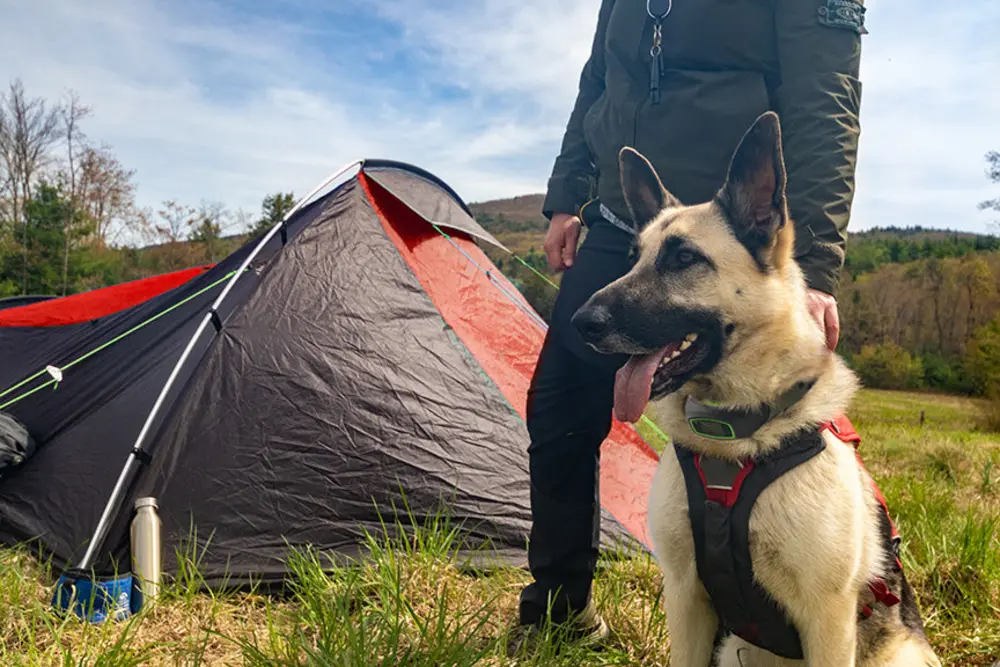
You know the rope. Twenty feet of it, tied off to a picnic table or a tent stake, and your dog on the end of it for five days while everyone else walks around free. He came on the trip. He is not really on the trip. By the second evening he has worn a bare arc into the dirt at the limit of the tether and he lies down in it and watches you.
Or it is the other version. A week at your in-laws' place, and the whole week is one long negotiation about a door. Somebody has to hold his collar before anyone opens it. Somebody forgets. He is down the street in nine seconds and you spend twenty minutes in a neighborhood you do not know, calling a name into other people's yards.
Every dog owner who travels has made this trade and mostly stopped noticing it. The dog comes along, and in exchange the dog gets smaller. Less range, less choice, more supervision, for the exact days you were hoping he would enjoy the most.
What almost nobody questions is why the trade exists at all. And the answer is not about your dog. It is about a very old assumption baked into what a fence is.
Part 01
A fence has always been a place
Think about what containment has actually meant for the last fifty years.
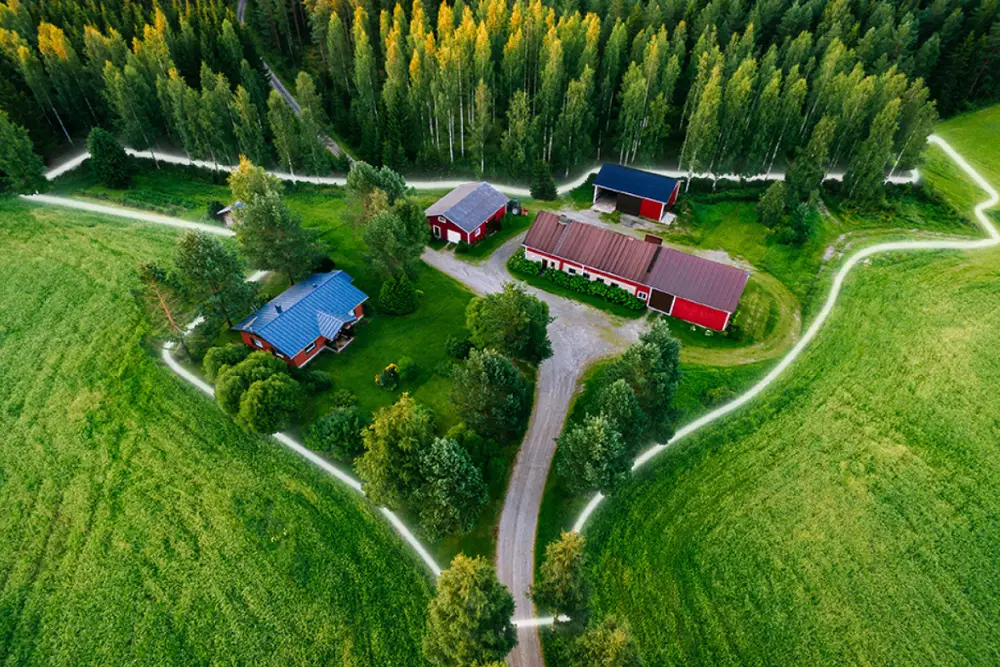
A buried wire fence is a trench. Somebody dug a loop around one specific lawn, dropped in one specific length of cable, and connected it to a transmitter screwed to one specific garage wall. The boundary is not a setting. It is landscaping. It is a permanent improvement to a piece of real estate you may not even own.
A wireless base station fence is a little better and fundamentally the same. It draws a circle, and the circle is centered on a box that has to be plugged in. Which means the boundary is centered on an electrical outlet, which means it is centered on a building, which means it is centered on a place.
Both of them answer the question "where can the dog go" with a physical object bolted to the ground. So when you leave the ground, you leave the answer behind, and the rope comes out of the trunk.
Buried wire and base stations
The boundary is hardware
A trench, a cable, a transmitter on a wall, or a plugged in box at the center of a circle. It belongs to one address.
A GPS boundary
The boundary is a file
Coordinates in an app and a collar that reads them. Nothing is installed, so nothing has to be left behind.
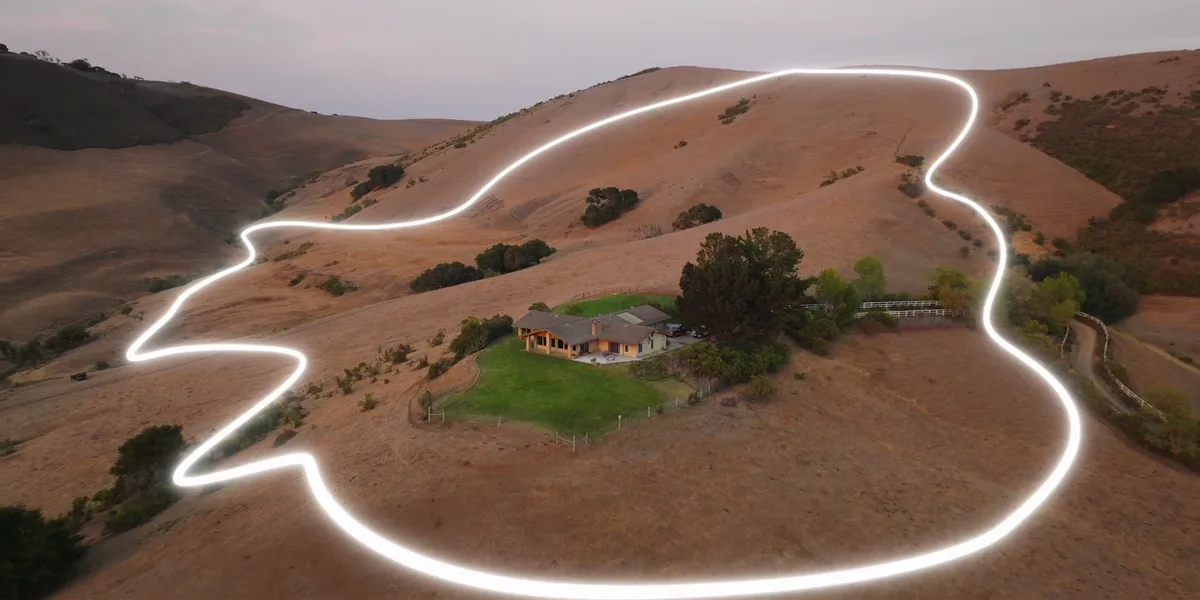
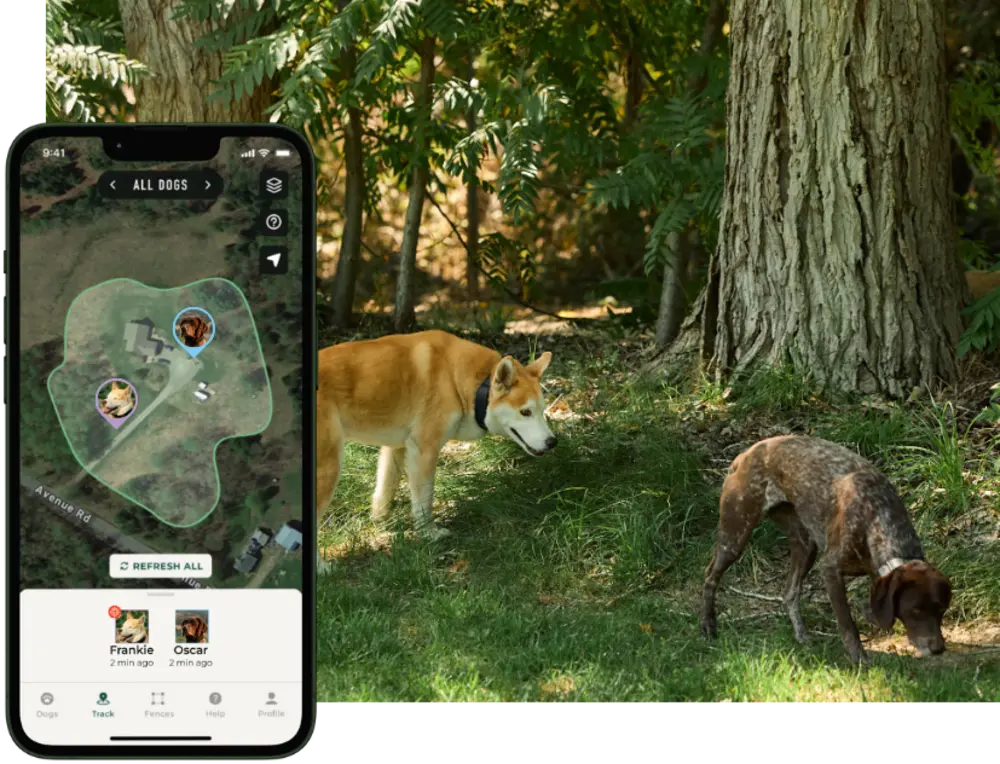
SpotOn's version of that second column is a collar that works out where it is, compares that to a shape you drew, and speaks up as your dog gets close to the edge. Their published range for a single fence runs from a third of an acre to more than 100,000 acres, and the company says the price is the same whichever end of that you use.
Part 02
The sentence that changes the category
Here is the objection everyone reaches for next, and it is a fair one. Fine, the boundary is portable. Is the dog portable? He spent weeks learning where the line is in your backyard. He knows it by the crooked pine and the corner of the shed. Take away the pine and the shed and surely you are starting over.
SpotOn answers this in their own training refresher, and they put it in capital letters, which tells you how often they get asked.
Your dog is trained to the tones, not your yard. SpotOn, "GPS Fence Refresher: Taking SpotOn with you on Vacation", published April 9, 2025 on spotonfence.com
Read that again, because it is the whole argument and it is easy to skim past. Your dog did not memorize a geometry. He learned a small, consistent sequence of sounds and what happens if he keeps walking into them. The landmarks were yours, not his. You are the one who needs the pine tree.
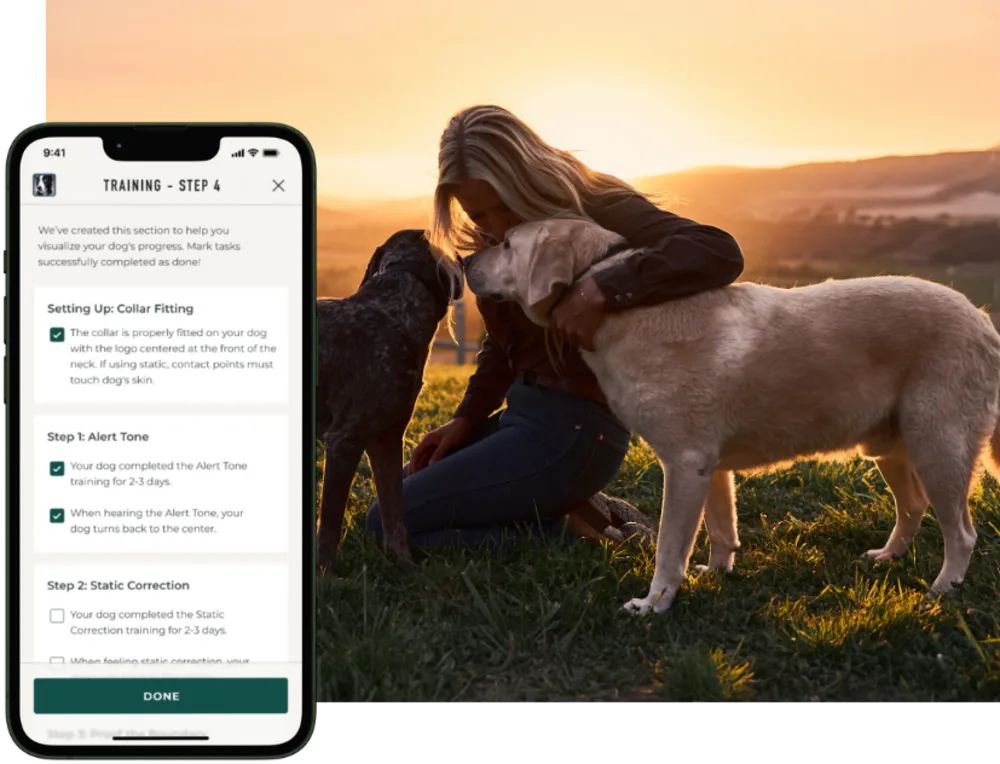
The sequence SpotOn publishes is three steps and it is the same everywhere:
What the collar does as the dog approaches the line
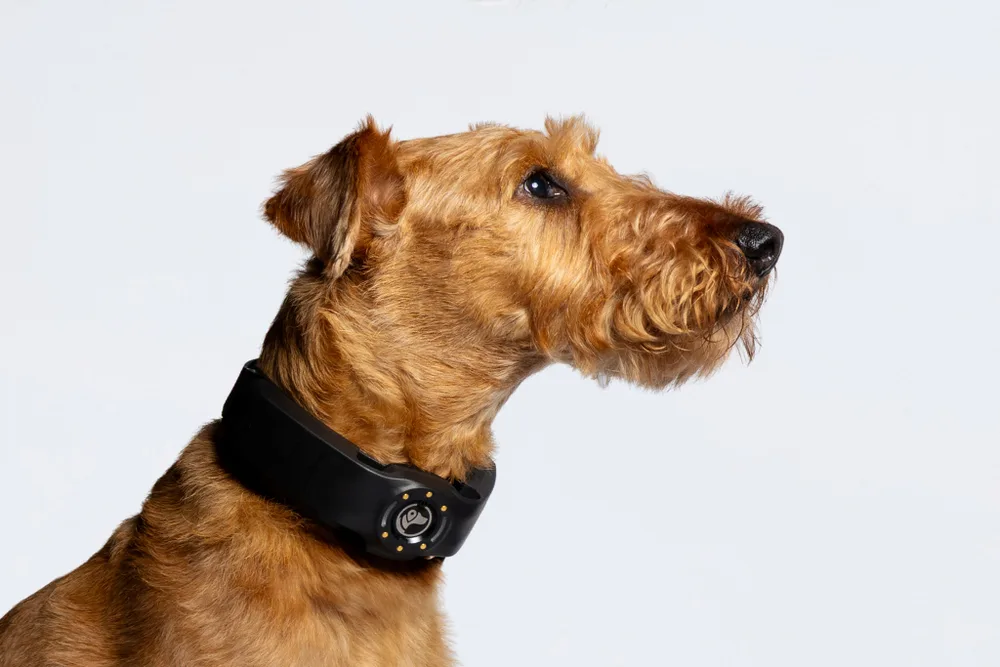
Two sounds, then a nudgeThe tones come first and they come at fixed distances. Most dogs never get past them.
Coming home is freeSpotOn says correction is disabled once the collar detects the dog is heading back into the safe area.
Nothing in that sequence refers to a location. It refers to a distance from a line, and the line is whatever you drew this morning. Which is why the same dog, with no retraining, respects a boundary at a campground he has never smelled before.
Part 03
Test it on your own lawn before you pack
You do not have to take any of that on faith, and you should not. SpotOn publishes a test you can run this afternoon, for free, with equipment you already own if you already own the collar.
The five minute check
- Take your dog outside and connect to the collar over Bluetooth.
- Walk him toward a spot that is normally well inside the safe area, nowhere near his usual boundary.
- Trigger the tones manually from the app.
- Watch what he does.
If he turns around, the boundary was never the fence line. It was the sound, and the sound travels with you. If he does not turn around, you have learned something more useful than any product page could tell you: the training needs another pass before you count on it three states away.
Source: SpotOn's own vacation refresher, spotonfence.com, April 9, 2025.
Part 04
What has to be true for a boundary to travel
Portability is the easy part to claim. Every GPS collar on the market can technically draw a shape anywhere. Three things have to hold before that shape is worth trusting on ground you have never walked, and this is where the products separate.
One: it has to land where you drew it
A GPS fence is only as good as the collar's idea of where it is standing. That error has a name, drift, and it is the reason a boundary can quietly move ten paces overnight and put a dog in a road that was safely outside the line yesterday.
SpotOn hired Spirent, an independent lab that specializes in GPS testing, and ran their Omni and Nova editions against the latest products from two market leading GPS dog fence brands in live outdoor environments in September 2025. Spirent is not a pet industry firm. Their published client list includes the European Space Agency, NASA, Qualcomm, Garmin, Toyota, Lockheed Martin and Meta.
Average GPS drift, September 2025
Independent testing by Spirent, commissioned by SpotOn. Lower is better. Competitor names were not published.
Open conditions
Under full tree canopy and around tall buildings
Figures as published by SpotOn on spotonfence.com. SpotOn summarizes the result as 7.3 times more accurate than the other GPS smart fences tested.
Look at the second block rather than the first, because that is the travel block. Open ground is the easy case and everybody looks acceptable there. The campsite you booked is under trees. The lake cabin is in a valley. The city visit is between buildings. In those conditions the two competing collars in this test drifted roughly the width of a tennis court, while SpotOn's stayed inside a single pace.
Two: it has to fire every single time
Accuracy is where the line is. Reliability is whether the collar actually says anything when the dog reaches it. The second one matters more for training, because a boundary that speaks up four times out of five is not a soft boundary, it is a confusing one. Your dog cannot learn a rule that is only sometimes a rule.
Warnings and corrections triggered as specified
Same Spirent field test. Higher is better.
SpotOn also publishes its own field figure for containment: dogs stayed inside their boundaries 99.3% of the time, and 0.0576% of breaches lasted longer than five minutes.
All three figures are SpotOn's own published specifications, from spotonfence.com.
Three: it has to work where there is no signal
This is the condition most people discover too late, usually at the trailhead, and it is the one that separates a collar you can travel with from a collar you can travel with as far as the last bar of service.
SpotOn states that cellular service and Wi-Fi are not required for its standard features, including creating unlimited fences. There is an Off-Grid Mode for places with no coverage at all, and a Forest Mode that raises GPS sensitivity under heavy tree cover. The optional real time tracking plan is the one thing that does need a cell signal, and it is worth being clear that those are two different features with two different requirements.
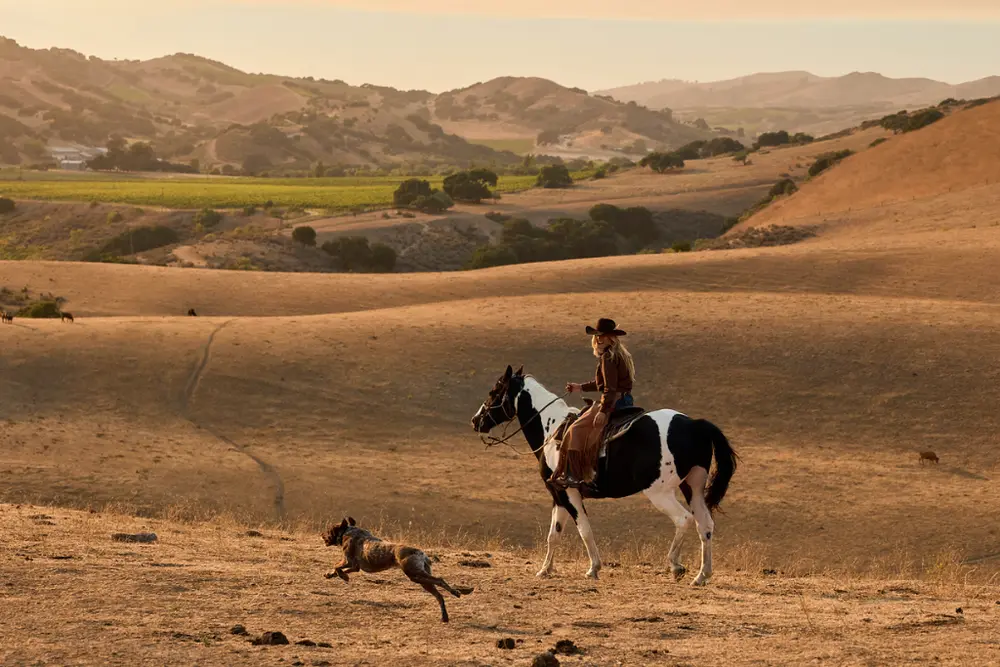

Official GPS collar of the American Kennel Club. SpotOn also states it designs, develops and manufactures in New Hampshire with domestic and international parts, and has been shipping GPS fences since 2019.
Part 05
How this actually goes, according to people who travel
The specifications tell you what is possible. What follows is what customers describe doing with it, published on SpotOn's own site.
★★★★★
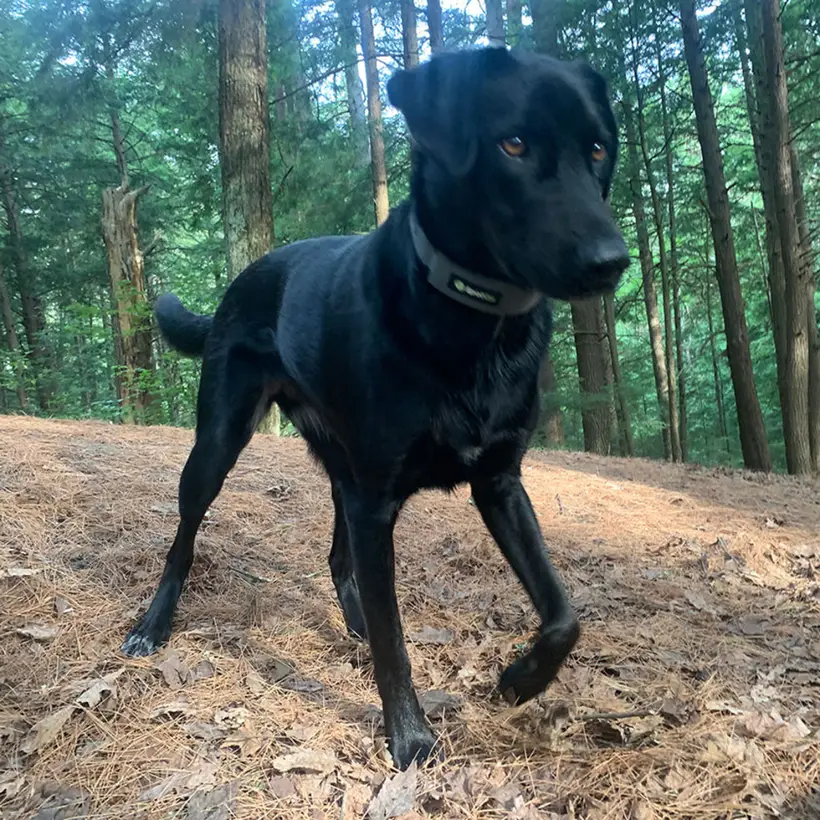
Camping! We just went on a five day camping trip! The tent site was fairly remote so we set up a 350 ft radius and didn't even bring a long tether.
Caitlin, on her dog Kenosha Published by SpotOn
That last clause is the whole thing in six words. Not "the tether was shorter" or "we used the tether less". They did not pack it.
★★★★★
We RV with our dog, Bo, and now use what we consider the best portable dog fence for camping.
Mike Wendland, RV Lifestyle Published by SpotOn
Mike and Jennifer Wendland are former journalists who now run an RV site, write guidebooks, host a podcast and spend roughly three quarters of the year traveling North America. They keep a 10 acre property in Michigan and a 5 acre one in Tennessee, and the same collar covers both plus wherever the van is parked.
★★★★★
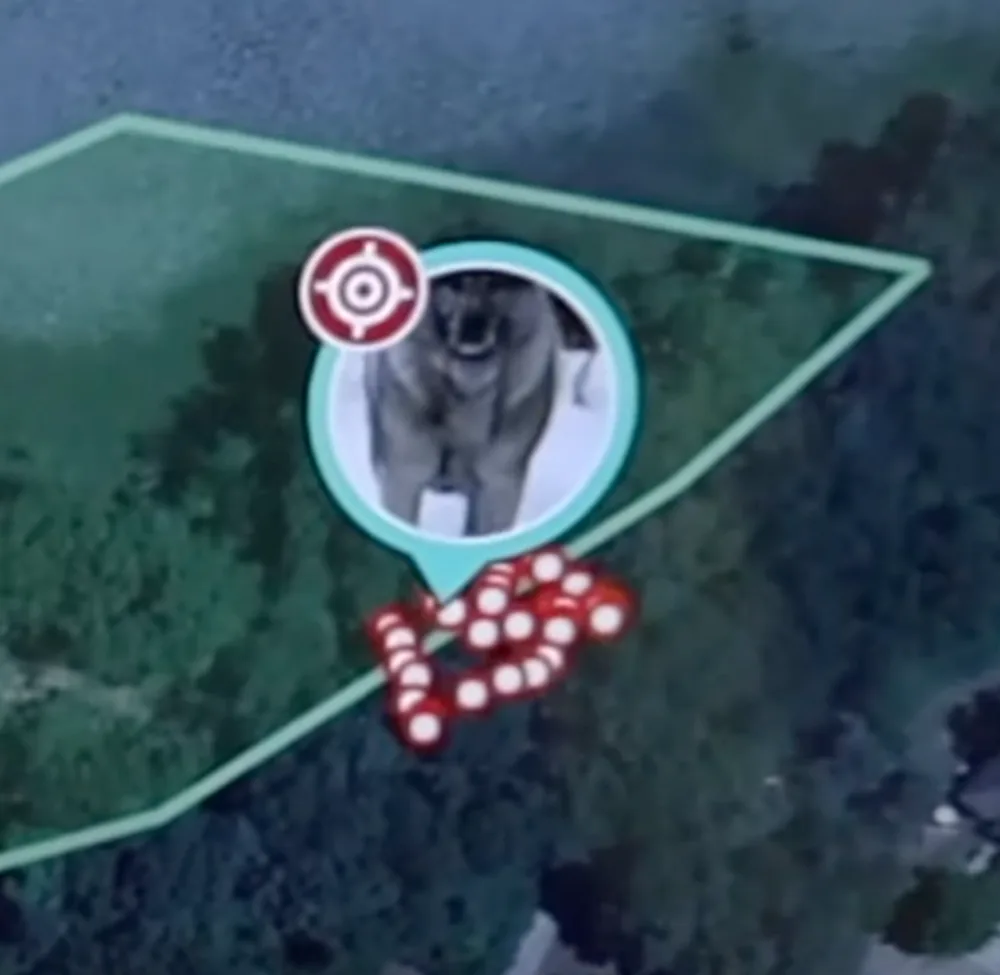
What do you do when your dogs disappear into the jungle for two weeks? For 14 days, my dogs chased wild boar into the jungle of Hawaii. I figured I would never see them again and I was completely consumed by guilt.
Nic C., Big Island, Hawaii Published by SpotOn
Nic's account is the most useful one on the site precisely because it starts with the failure. He had taken normal precautions. He also says he rejected the obvious fix, in plain terms: "Tying them up or building a small run just wasn't the lifestyle that I wanted for my dogs." What he says he uses now: "The incredible off-grid feature allows me to create fences in remote areas without service."
★★★★★
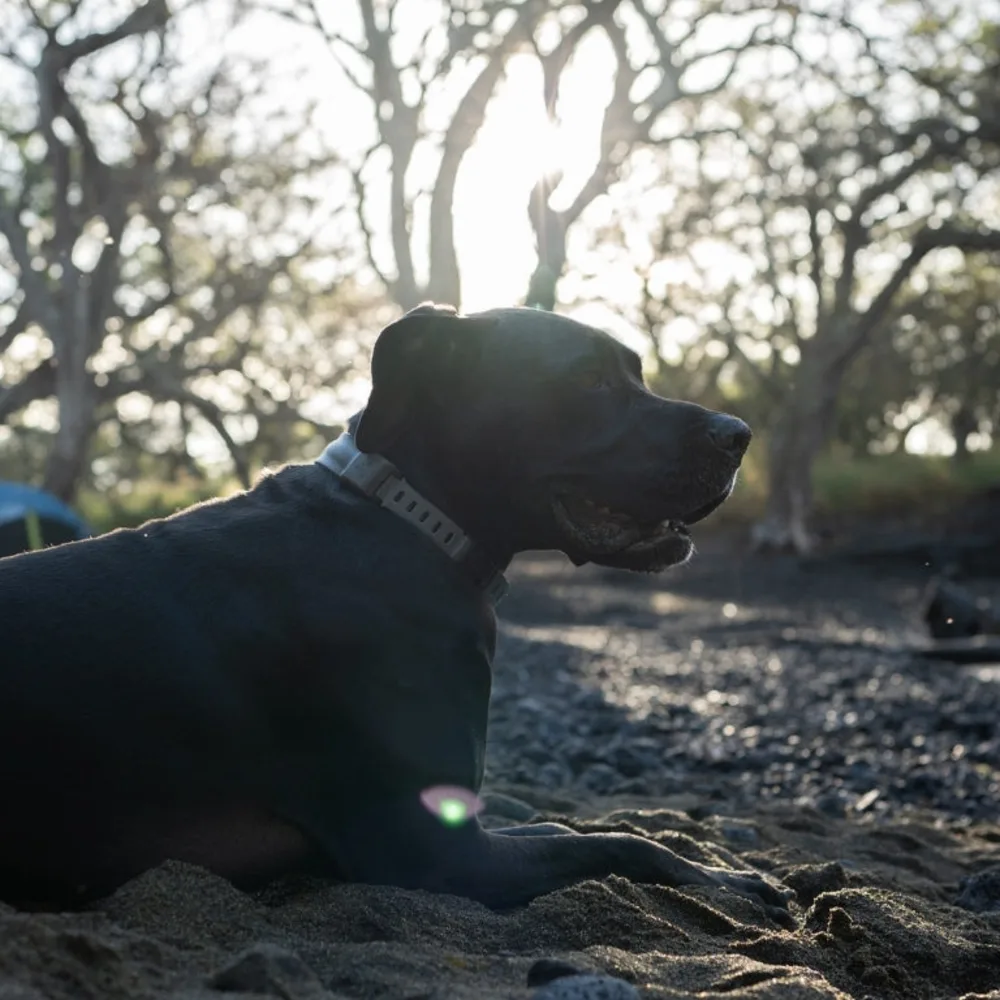
This collar gives me peace of mind while giving my dog freedom. Anytime we travel I set up a perimeter before we arrive. We put the collar on him right before he gets out of the car and off he goes!
Philippa, Alabama Published by SpotOn
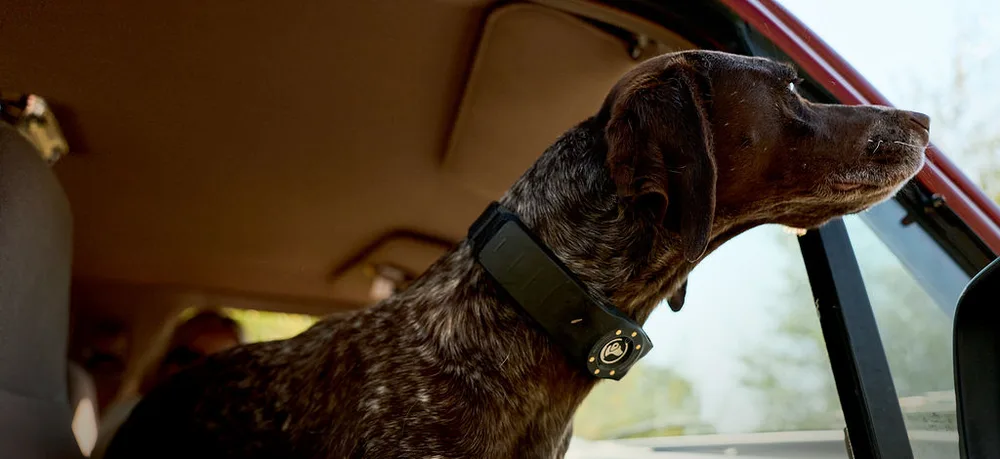
Philippa describes the routine that makes the difference, and it is worth stealing whether or not you buy anything: draw the fence before you leave, not after you arrive. You can pull up satellite imagery of the campsite, the cabin, your sister's back field, and trace the shape on the couch the night before. Then the collar goes on in the parking lot and the trip starts immediately instead of after an hour of setup with everyone waiting.
Part 06
The first hour at a place you have never been
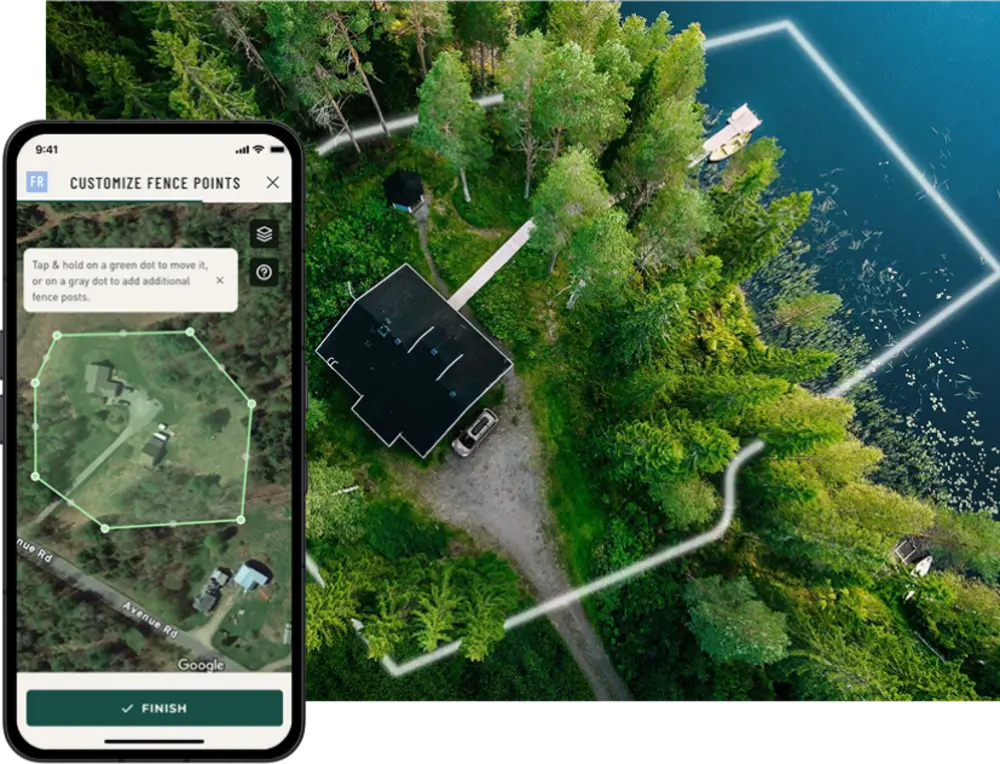
Two ways to make the boundary exist. You can walk the perimeter with the collar in your hand and let the app record the shape as you go, which is the intuitive one and takes as long as walking it. Or you can draw and edit it directly on the map, which is what you want for the night before.
There is also an instant perimeter: a circle centered on wherever you are standing, in a set of preset sizes. That is the campground answer. Park, stand at the tent pad, pick a radius, done. It is the feature Caitlin was describing with her 350 feet.
One collar, three saved boundaries
Same collar, same two tones, same dog. SpotOn advertises unlimited saved fences at no extra cost, which is what turns three trips into three shapes instead of three problems.
SpotOn publishes three constraints that are easy to get wrong on unfamiliar ground, and they are the most useful part of their whole travel guide:
| Rule | The number | Why it bites on a trip |
|---|---|---|
| Minimum area | Half an acre or more | A tight campsite loop means the dog is inside the warning zone constantly and never gets a quiet middle. |
| Narrowest point | At least 80 feet wide | A pinched corridor between a shed and a treeline reads as boundary on both sides at once. |
| Buffer from hazards | At least 15 feet | Roads and rail lines you did not choose and cannot see from the site. SpotOn puts typical GPS shift at 3 to 10 feet. |
Source: SpotOn's published fence creation guidance, spotonfence.com.
Then the arrival routine, which takes about as long as unpacking the car:
- Start on leash and walk the boundary together, stepping just into the alert tone and encouraging him to turn back. Mark it and treat it.
- Once he is turning on his own, drop to a long line, then off leash, and watch what he does as he approaches the edge.
- Proof it deliberately. Have someone he likes stand outside the line and call. If he hears the tone and turns anyway, you are done.
- Note a landmark or two for yourself. He does not need them. You will want them at dusk.
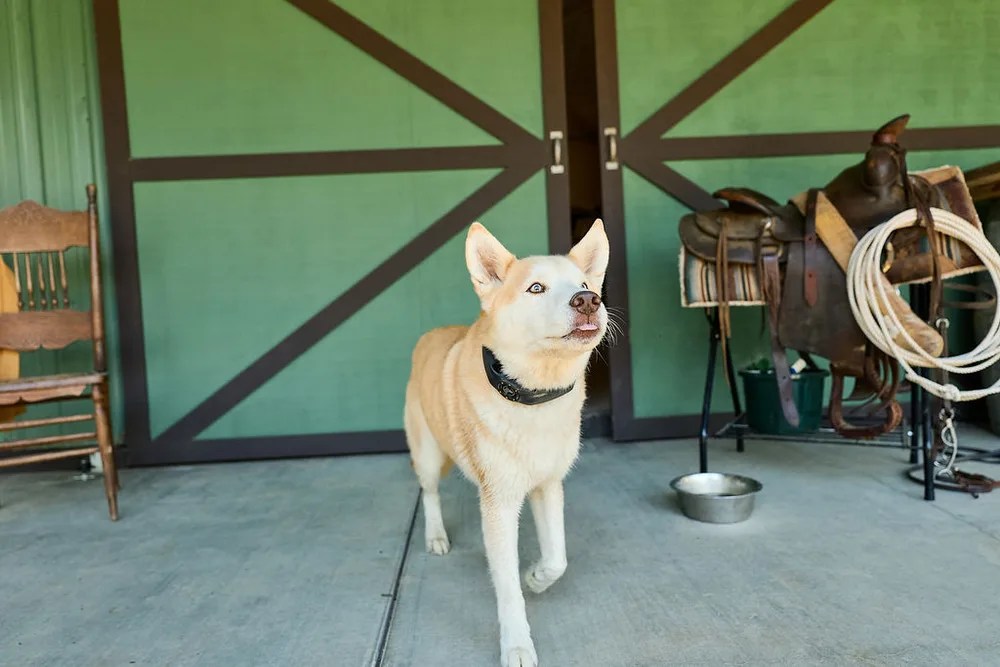
One more setting worth knowing before you travel: a Home Zone lets the collar stay on indoors, or in a barn or garage, without throwing false corrections at a dog who is simply lying under a table. On a trip, where the dog is in and out of an unfamiliar building all day, that is the difference between a system you use and a system you take off and forget to put back on.
Part 07
Where this does not fit
An honest version of this page has to include the cases where the answer is no, because the failures are predictable and they are all published.
- Small properties. SpotOn says the system works best from half an acre up. Below that your dog spends his time inside the warning band, which is unpleasant and teaches him nothing.
- Small dogs. The collar fits dogs of at least 15 pounds with necks measuring 10 to 26 inches. Outside that range it is not a judgment call, it simply does not fit.
- Strong prey drive. SpotOn says these dogs can be trained successfully but that practicing around real distractions is essential. A deer at a campground is a harder test than anything in your backyard.
- Time. Roughly fifteen minutes a day, and most dogs take a few weeks. You cannot buy this on a Thursday and trust it on a Saturday trip. If you leave next week, this is a decision for the trip after.
- Live tracking. Containment does not need a subscription or a signal. Watching your dog move on a map in real time needs both, and it is sold separately.
★★★★★
The system was super easy to set up and the location of the boundary has been reliable, even in the woods.
Charlotte, Virginia Published by SpotOn
★★★★★
Not inexpensive, but personally I would rather pay more for a product that works all of the time.
Jeffrey L. Verified customer
Part 08
What it costs
There is no soft way to say this and no reason to bury it. This is a serious piece of equipment at a serious price, and Jeffrey up there put it better than any marketing copy would.
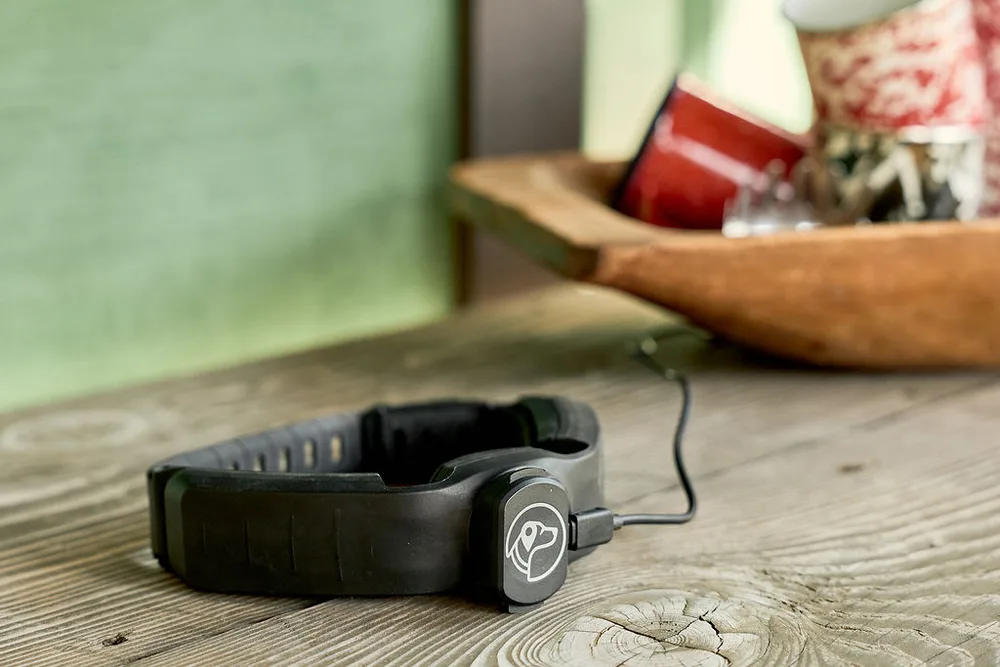
SpotOn GPS Dog Fence
Nova Edition, launched January 2026. Omni Edition also still sold.
$999 Nova · $899 Omni
- No subscription is required to contain your dog. Unlimited fences are included. The real time tracking plan is optional and separate.
- $100 off each additional collar at checkout, for multi dog households.
- 0% APR financing on qualified 12 month plans, plus interest free installments through PayPal or Shop Pay.
- 90 day money back guarantee, described as no questions asked, plus a one year warranty and one no questions replacement for a lost or dog damaged collar.
- Free one to one training included with the collar.
- Rated IP67, built for rain, snow, swimming and temperatures from minus 30°F to above 120°F.
The 90 day window is the number that matters for a travel purchase, because it is long enough to cover the training and an actual trip. That is the only real test, and it is the one you can run before the money is spent for good.
See the SpotOn Nova EditionPrices, sizing and the full spec list on spotonfence.comPart 09
The rope was never about your dog
Go back to the campsite at the start. The reason your dog spent five days on twenty feet of rope was not his recall, his breed or his temperament. It was that the only boundary he had ever been given was welded to a piece of ground three hundred miles away.
Change what a boundary is made of and that constraint just stops applying. He already knows the rule. He learned it as a sound, and the sound fits in a bag.

Questions
The ones people actually ask
Does my dog need retraining at every new place?
SpotOn's position is no, because the training is to the tones rather than to a location. Their own advice is still to walk the new boundary with him on leash on arrival, which takes a few minutes and settles it.
Will it work with no cell service?
SpotOn states that cellular service and Wi-Fi are not required for standard features, including creating fences, and there is an Off-Grid Mode for remote areas. Live tracking is the exception and does need a signal.
What about heavy tree cover?
There is a Forest Mode that increases GPS sensitivity under canopy. In the Spirent test, SpotOn's drift under full canopy and around tall buildings was measured at 2.7 feet for Nova and 3.7 feet for Omni, against 30.5 and 28.6 feet for the two other brands tested.
Is it a shock collar?
The sequence is a tone at ten feet, a second tone at five, then a vibration and an optional static correction at the line, with 30 levels to choose from. SpotOn says correction is disabled once the collar detects the dog returning to the safe area.
Can I save more than one fence?
Yes. SpotOn advertises unlimited saved fences at no extra cost, which is what makes the home, the in-laws and the usual campground three saved shapes rather than three setups.